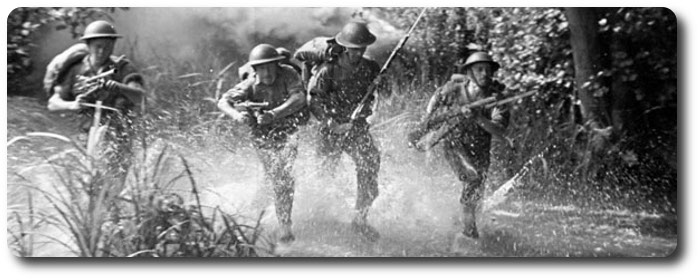
The Officer and Fighting Efficiency (1940)
Table of Contents - Chapter - I - II - III - IV - V - VI
CHAPTER VI
CONCLUSION: THE ARMY AS A FIGHTING INSTRUMENT
It has been remarked that the immediate task of every officer is the building up of an army; it is equally his responsibility to see that this army shall understand that its first business is to fight.
Troops must not be led into battle in the belief that the "prepared positions" to their rear exist primarily to offer them refuge in face of a determined enemy. Over-reliance on static defensive measures and concrete fortifications will kill the fighting spirit of any army, and any officer who examines a prepared position with the unspoken thought, "This is where I fall back to." fails in the first essential of leadership - a resolve to win the day.
It must be realized and impressed on all ranks that the soldier is equipped with weapons not for self defence but to kill his enemy, and that he will fail in his purpose if he has not taken heavy toll of enemy life. “If you fight with dogs you must bite like a wolf." Training must therefore have one end in view-the killing of Germans, so long as they are prepared to fight. The bulls-eye and the bayonet fighting sack must be represented as German soldiers, who will kill unless they are first killed.
"Example is Everything"
No exceptional measures should be necessary to instil this fighting spirit. If troops are well disciplined and physically, fit, well trained in the use of 1 heir weapons, and satisfied that they have a very necessary job of work on hand for their country, they will fight bravely.
Nevertheless, the sternest test of discipline must always be reserved for the leader - the officer. In battle, example is everything. One determined officer can sway the fortunes of a whole front. The test is, further, one of self discipline; and the ability to stand up to it can come only through the officer's personal resolve never to falter in face of the enemy, and to see that he and his troops carry out their allotted tasks, no matter what is happening to the left, to the right, or in rear of them. Men who are well led will never fail even though their leader may be killed.
"The Hero"
For an officer or leader who carries out this resolve the maintenance of esprit de corps and discipline will not be difficult, for his efforts will be reinforced by hero worship. Few men are too “superior" to have their heroes, and the moment the hero emerges, conduct ceases to be passive and becomes an active and positive urge to do what the hero does or the kind of things he would approve. One of the most significant services that a dominant leader ever renders to a body of men is to provide its members with a hero.
The British Army of to-day is a new army, but it has great traditions and, under the inspiration of good leadership, it will know how to fight. The future of this growing Army largely depends on the junior leader. His responsibilities are heavy; but we have proved in the past that we have the right breed. At the present time no better advice can be given him than, “Know your men and care for them. Go in with your men, lead them, and fight. Stick to your men, and fight on. Never give in, and never look over your shoulder."
- The O'Leary Collection; Medals of The Royal Canadian Regiment.
- Researching Canadian Soldiers of the First World War
- Researching The Royal Canadian Regiment
- The RCR in the First World War
- Badges of The RCR
- The Senior Subaltern
- The Minute Book (blog)
- Rogue Papers
- Tactical Primers
- The Regimental Library
- Battle Honours
- Perpetuation of the CEF
- A Miscellany
- Quotes
- The Frontenac Times
- Site Map
QUICK LINKS
- The Senior Subaltern
- Staff Duties and the Young Officer
- How to Write Effective English
- Notes and Quotes - Staff Duties
- Advice to Officers (1782)
- Mess Rules of the Infantry School (1884)
- A Dozen Military Epigrams (1901)
- How The Loafer's Bred (1904)
- The Promotion and Examination of Army Officers (1904)
- A Few Tips for Officers, Before and After Joining (1906)
- Standing Orders of The RCR (1910)
- Standing Rules for Officers' Messes of The RCR (1913)
- The Young Officer's Guide to Knowledge (1915)
- The Duties of an Officer (1916)
- An Open Letter to the Very Young Officer (1917)
- Advice to a Young Officer (1917)
- Battalion Duties; Officers, NCOs, and Soldiers (1917)
- Pleasing Infantry Brigadiers (1917)
- Role and the Responsibilities of the CO in a Battalion Mess (1917)
- The RCR, "A" Company Standing Orders (1918)
- Some Staff Duties (1923)
- An Officer's Code (1925)
- Hints on Promotion Exams (1925)
- On Writing Appreciations (1926)
- The RCR; Rules for Officers' Messes (1927)
- Morale And Leadership (1929)
- RCSI Hints for Young Officers (1931)
- RCSI Notes on Drill (1931)
- The Study of War by Junior Officers (1932)
- Self-Training (1934)
- "The Problem of the First Ten Years" (1934)
- Standing Orders of The RCR; 1935)
- Customs of the Service (1939)
- Drill and Discipline (1939)
- Leaders Win Where Commanders Lose (1939)
- The Officer and Fighting Efficiency (1940)
- Officers' Mess (RCAF, 1940)
- The Duties of an Officer (1942)
- Comrades in Arms (1942)
- Example Standing Orders - Subalterns (1942)
- Hints for Newly Commissioned Officers (1943)
- Completed Staff Work (1943)
- FOLLOW-ship (1943)
- Hints for Junior Officers (1945)
- Officer-Like Qualities (1948)
- Military Writing (1948)
- An Analysis of the Sub-Unit Commander (1949)
- Leadership (1950)
- Neptune's Notes (undated, 1950s-60s)
- Thinking and Writing (1953)
- Examination Tactics (1953)
- Officers (1954)
- On Writing Examinations (1954)
- Customs of the Army (1956)
- 1st Bn, The RCR, Senior Subaltern (1956)
- Pigs Have Wings (1960)
- Leadership and Man Management (1960)
- Officers (1964)
- 1RCR - The Sergeants' Mess - "Tips" (1971)
- 2RCR Junior Officer's Handbook (1973)
- How to be a Successful Subaltern (1978)
- Foreword to the Infantry Journal, No. 8 (1979)
- Do You Appreciate the Finer Points of Life? (1980)
- The RCR Regimental Standing Orders - Senior Subaltern (1992)
- Infantry Company Command (2016)
- A Miscellany of Advice for Subalterns
- The Young Officer and the NCO - Quotes