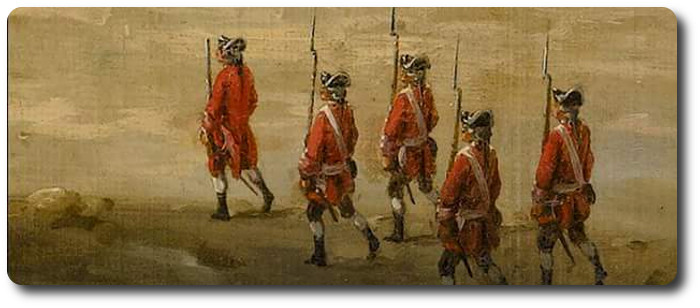
Advice to the Officers of the British Army
with the addition of some hints to the drummer and private soldier
A Major, for instance, will probably enjoy every Chapter except that addressed to officers of his own rank, which he will not relish at all.
Introduction by Bernard Fergusson
London; Jonathan Cape, 30 Bedford Square First published 1782, this edition 1946
Contents
- Introduction
- Chap. I - To Commanders-in-Chief
- Chap. II - To General Officers on the Staff
- Chap. III - To Aid-de-Camps of General Officers
- Chap. IV - To Colonels and Lieutenant-Colonels commanding corps
- Chap. V - To Majors
- Chap. VI - To the Adjutant
- Chap. VII - To the Quarter-Master
- Chap. VIII - To the Surgeon
- Chap. IX - To the Chaplain
- Chap. X - To the Paymaster
- Chap. XI - To the Young Officers
- Chap. XII - To the Serjeant-Major
- Chap. XIII - To the Quarter-Master-Serjeant
- Chap. XIV - To the Serjeant
- Chap. XV - To the Corporal
- Chap. XVI - To the Drum-Major
- Chap. XVII - To the Drummer
- Chap. XVIII - To the Private Soldier
Introduction
Those who have the good fortune to. know both Frankie Wilson and the book which he has now illustrated, will applaud his choice, and settle down to enjoy it with a sure anticipation. Both in custom and in costume, the profession of arms has sadly changed for the worse, in the hundred and sixty years that have passed between the first and the present appearance of the book. But the cynicism that flourished under the tricorne of the 1780's will still feel at home under the horrible beret of the 1940's. And the anonymous author would certainly rejoice in his affinity with the illustrator, which so lightly and happily spans the intervening years.
The author has already had his imitators. There was the Drillbook of General D' Ordel; there was the Young Officer's Guide to Knowledge: each was the source of maxims which have earned the proud status of being quoted without acknowledgment. "The arms should hang lightly from the shoulders--and not from the hips or thighs." "The head, should be retained erect--and not thrown away." "Always ask for leave at all times and in all places, and in time you will acquire a right to it." "It is better to incur a slight reprimand than to perform an unpleasant duty." But the present book is the common ancestor of both, and as such worthy of our attention, and well worthy of Frankie's.
The author's mastery of his subjects may be not unfairly gauged by the reaction of the subjects to their author. A Major, for instance, will probably enjoy every Chapter except that addressed to officers of his own rank, which he will not relish at all. Officers with a wider view, such as myself, will applaud that Chapter, and most of the others, although there are indeed lapses of taste in the Chapters on "General Officers on the Staff" (which apparently includes Brigadiers) and on "Aid-de-Camps of General Officers". I have occupied both positions, and both these portraits are certainly out of perspective. But there is an earlier Chapter, which I dare not specify, in which all but a round dozen officers may rejoice; and how sound is our author on the subject of paymasters!
Mutatis mutandis, the same remarks apply to Frankie and his drawings. I have long enjoyed his caricatures. When he was a Royal Scots Fusilier, and before the solitary flaw (a taste for horses) in his otherwise beautiful character drove him to transfer his allegiance to a regiment of Indian Cavalry, I had the honour to enjoy the hospitality of the mess to which he belonged. I was able, without hesitation, to put the correct name to each officer as I made his acquaintance, with the sole aid of an album of caricatures drawn by Frankie, in which the facial eccentricities of each were recorded. This was invaluable in my then capacity of Aid-de-Camp to a General Officer (though nothing like the picture on page 25). Yet even Homer nods; and whereas Frankie's pictures were the very spit of their subjects in all other cases, he was scarcely successful in his efforts at drawing me. I can never understand why other people seemed to like them.
But I was his only failure, and here he is on firm ground. Here he has made to posture and strut before us the butts of another age, the butts whom our forefathers mocked in their day, with the same good-humoured impiety as we have used ourselves. These were the sallies at which they laughed, sitting over the silver which we have known in our own messes, or bivouacked on the same battlefields. The costumes and the wear-ons may have changed a lot, and the language a little; but we are still the same Regiments and, above all, the same Army.
Bernard Fergusson.
- The O'Leary Collection; Medals of The Royal Canadian Regiment.
- Researching Canadian Soldiers of the First World War
- Researching The Royal Canadian Regiment
- The RCR in the First World War
- Badges of The RCR
- The Senior Subaltern
- The Minute Book (blog)
- Rogue Papers
- Tactical Primers
- The Regimental Library
- Battle Honours
- Perpetuation of the CEF
- A Miscellany
- Quotes
- The Frontenac Times
- Site Map
QUICK LINKS
- The Senior Subaltern
- Staff Duties and the Young Officer
- How to Write Effective English
- Notes and Quotes - Staff Duties
- Advice to Officers (1782)
- Mess Rules of the Infantry School (1884)
- A Dozen Military Epigrams (1901)
- How The Loafer's Bred (1904)
- The Promotion and Examination of Army Officers (1904)
- A Few Tips for Officers, Before and After Joining (1906)
- Standing Orders of The RCR (1910)
- Standing Rules for Officers' Messes of The RCR (1913)
- The Young Officer's Guide to Knowledge (1915)
- The Duties of an Officer (1916)
- An Open Letter to the Very Young Officer (1917)
- Advice to a Young Officer (1917)
- Battalion Duties; Officers, NCOs, and Soldiers (1917)
- Pleasing Infantry Brigadiers (1917)
- Role and the Responsibilities of the CO in a Battalion Mess (1917)
- The RCR, "A" Company Standing Orders (1918)
- Some Staff Duties (1923)
- An Officer's Code (1925)
- Hints on Promotion Exams (1925)
- On Writing Appreciations (1926)
- The RCR; Rules for Officers' Messes (1927)
- Morale And Leadership (1929)
- RCSI Hints for Young Officers (1931)
- RCSI Notes on Drill (1931)
- The Study of War by Junior Officers (1932)
- Self-Training (1934)
- "The Problem of the First Ten Years" (1934)
- Standing Orders of The RCR; 1935)
- Customs of the Service (1939)
- Drill and Discipline (1939)
- Leaders Win Where Commanders Lose (1939)
- The Officer and Fighting Efficiency (1940)
- Officers' Mess (RCAF, 1940)
- The Duties of an Officer (1942)
- Comrades in Arms (1942)
- Example Standing Orders - Subalterns (1942)
- Hints for Newly Commissioned Officers (1943)
- Completed Staff Work (1943)
- FOLLOW-ship (1943)
- Hints for Junior Officers (1945)
- Officer-Like Qualities (1948)
- Military Writing (1948)
- An Analysis of the Sub-Unit Commander (1949)
- Leadership (1950)
- Neptune's Notes (undated, 1950s-60s)
- Thinking and Writing (1953)
- Examination Tactics (1953)
- Officers (1954)
- On Writing Examinations (1954)
- Customs of the Army (1956)
- 1st Bn, The RCR, Senior Subaltern (1956)
- Pigs Have Wings (1960)
- Leadership and Man Management (1960)
- Officers (1964)
- 1RCR - The Sergeants' Mess - "Tips" (1971)
- 2RCR Junior Officer's Handbook (1973)
- How to be a Successful Subaltern (1978)
- Foreword to the Infantry Journal, No. 8 (1979)
- Do You Appreciate the Finer Points of Life? (1980)
- The RCR Regimental Standing Orders - Senior Subaltern (1992)
- Infantry Company Command (2016)
- A Miscellany of Advice for Subalterns
- The Young Officer and the NCO - Quotes