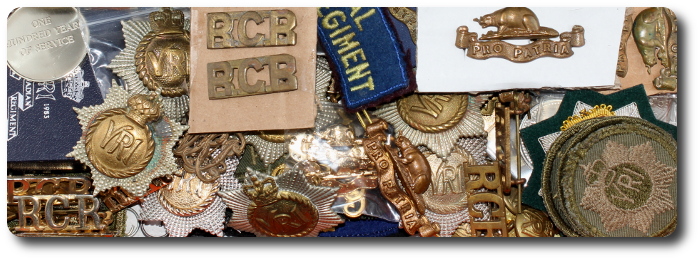
Badges of The Royal Canadian Regiment
1980s
Notes and References
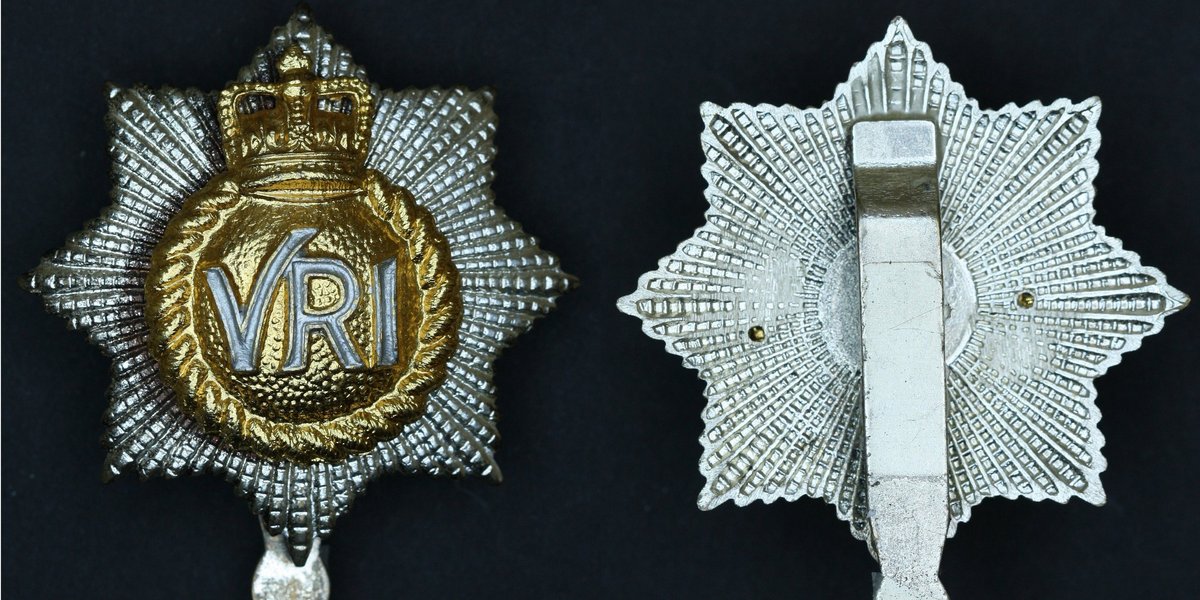
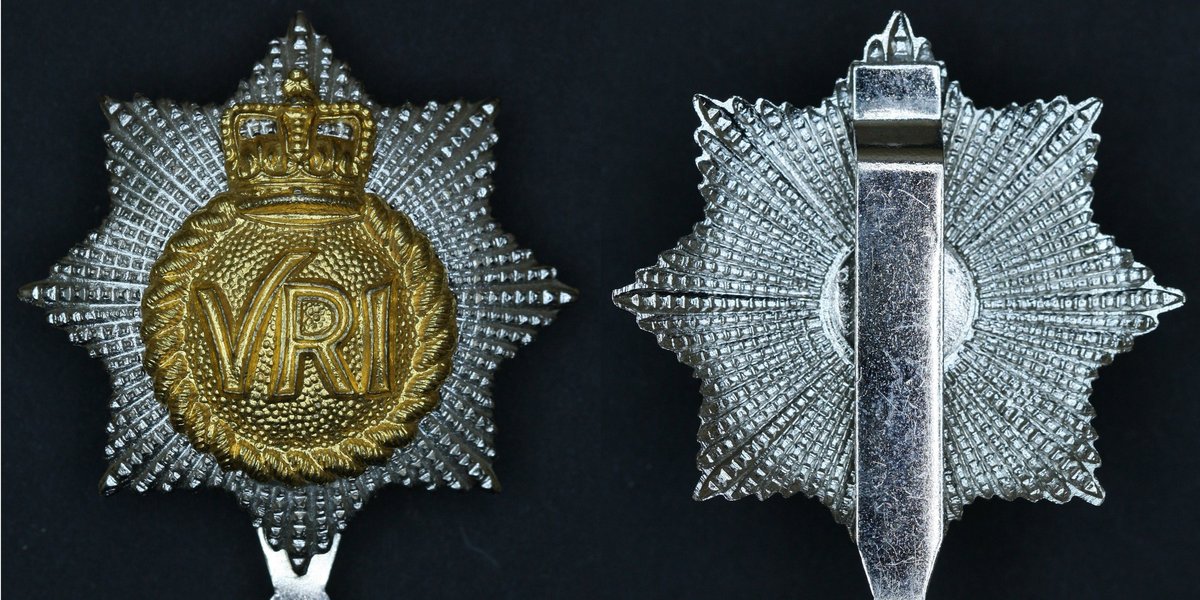
These badges were issued during the 1980s, and show the change of the backplate from the stamped version of the previous decades to a somewhat more finely detailed variation of highly convex stars with deeply incised radial and concentric lines.
These badges have a wide-based Imperial crown on a stamped front piece with raised edged block letters in the cypher.
Versions of these badges can be found with the "VRI" painted in. This was done by officers in the Regiment to create an officer's variation. There were no badges produced of these editions with silver lettering, and as young officers were instructed to correct their badges, this would make the painted copies a recognized "official" variant.
The latter badges, with the proper "diamond cut" star is the culmination of correspondence between The Regiment and Directorate of Ceremonial through the early 1970s. This letter series (RCR Museum document set 14-4767-1983), which pursued authority to change the backing of the issued badge from the stamped pattern, which was described as "a weak imitation of the diamond cut" on the then current officers' badge. In later letters, Director Ceremonial noted that samples should be produced with "gold-plated crown and circular device instead of the present yellow brass." (RCR Museum document package 14-4767-1883, letter dated 23 Mar 1971)
This requested change to the diamond cut star evidenced itself in the 1980s, perhaps as existing stocks were depleted and refreshed with a new order of badges. These badges also had a highly convex profile, more so than any previous badges, and very distinctly different from the officer's badge the diamond cut star was to follow: "The back plate on the Officers' cap badge is aluminum alloy and flat in construction, ..." (RCR Museum document package 14-4767-1883, letter dated 18 Mar 1971).
The first such badges with the diamond cut star retained the cypher and crown of their immediate predecessors. It was not until the 1990s that a new front piece came into service.
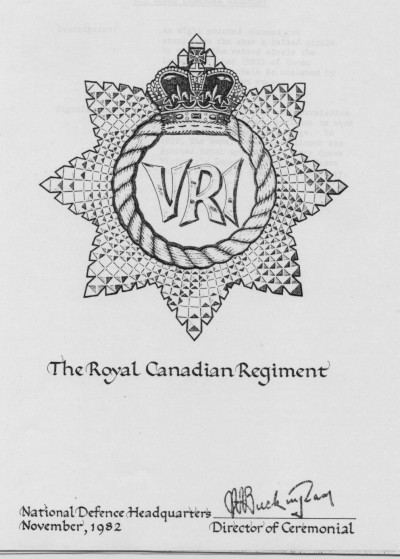
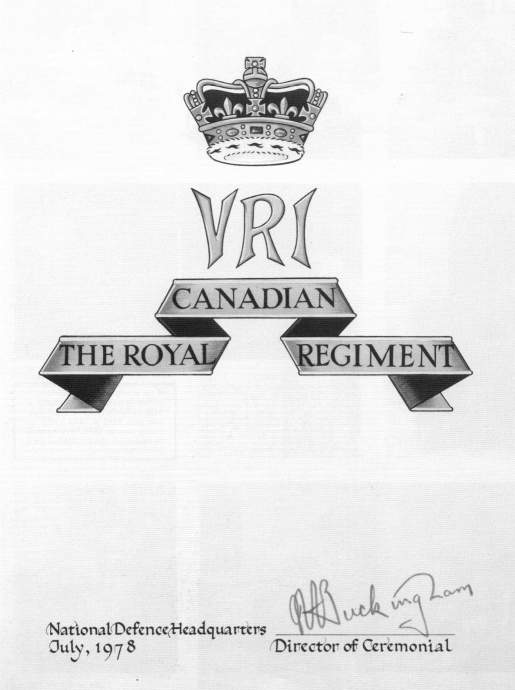
In November 1982, a new drawing of the Regimental badge was authorized by the signature of N.A. Buckingham, Director of Ceremonial at National Defence Headquarters.
The Royal Canadian Regiment
| Description: | An eight pointed diamond cut star; upon the star a raised circle Or within the raised circle the Imperial Cypher (VRI) of Queen Victoria. The whole is ensigned by the Imperial Crown proper. |
| Significance: | In 1894 Queen Victoria gave permission for The Royal Canadian Regiment to wear her Imperial Cypher as a badge. In1919, The Royal Canadian Regiment was granted Royal approval to carry Queen Victoria's Imperial Cypher and Crown on the Regimental Badge in perpetuity. |
(RCR Museum, document 14-4767-1983)
The change to the cypher lettering, which differed from the block letters of the prior few decades and from the narrow letters on the 1894 pattern and early St Edward's crown variations. The new letter design is based on the Regimental Cypher authorized in 1978. (5250-1 (RHQ) 15 Oct 82, RCR Museum, document 14-4767-1983)
- The O'Leary Collection; Medals of The Royal Canadian Regiment.
- Researching Canadian Soldiers of the First World War
- Researching The Royal Canadian Regiment
- The RCR in the First World War
- Badges of The RCR
- The Senior Subaltern
- The Minute Book (blog)
- Rogue Papers
- Tactical Primers
- The Regimental Library
- Battle Honours
- Perpetuation of the CEF
- A Miscellany
- Quotes
- The Frontenac Times
- Site Map
QUICK LINKS
1. Introduction
2. Crowns, Cyphers and Controversy
3. Rare and Unusual Regimental Badges
4. Shoulder Flashes and Titles
1883
1894-1902, 1919-27
South African War
EviiR Badges (1902-11)
GvR Badges (1911-19)
St Edward's Crowns (1927-70s)
Maj Cock, M.C., Collection (1933)
Imperial Crowns (1926-50s)
Imperial Crowns (1960s-80s)
Dress Regs - 1960
Dress Regs - 1967
1980s
1990s
2000+
Woven Badges
Blazer Badges
Pipers' Badges
Belt Buckles
Miscellaneous
Crowns, Cyphers and Stars
RCR Headdress
Badged Brodies
Badge References