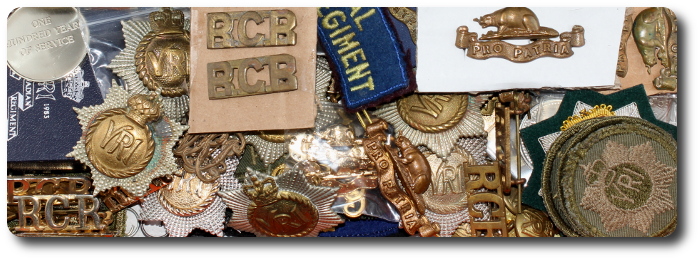
Badges of The Royal Canadian Regiment
1883 - 1894
1883 Infantry School Corps Helmet Plates, Officers' Bullion Badges and Cap Badges

Notes and References
On December 21, 1883, General Order No. 26 authorized the formation of three schools of infantry, to be formed into one Corps, to be known as the Infantry School Corps.
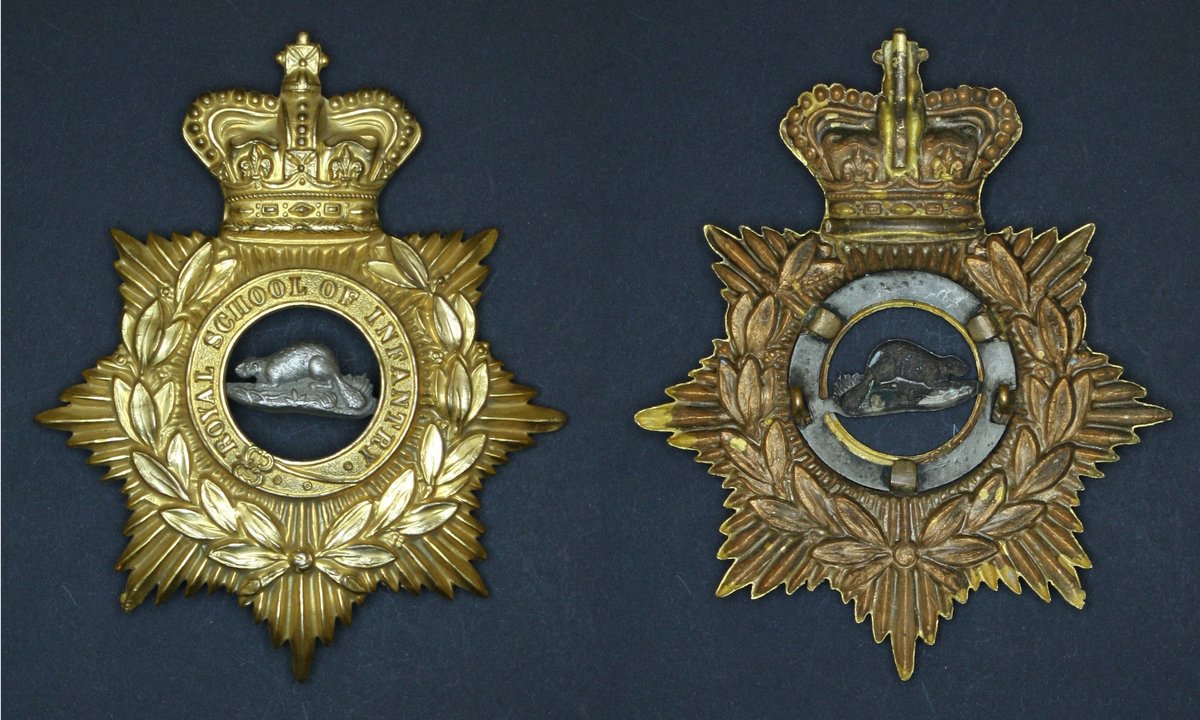
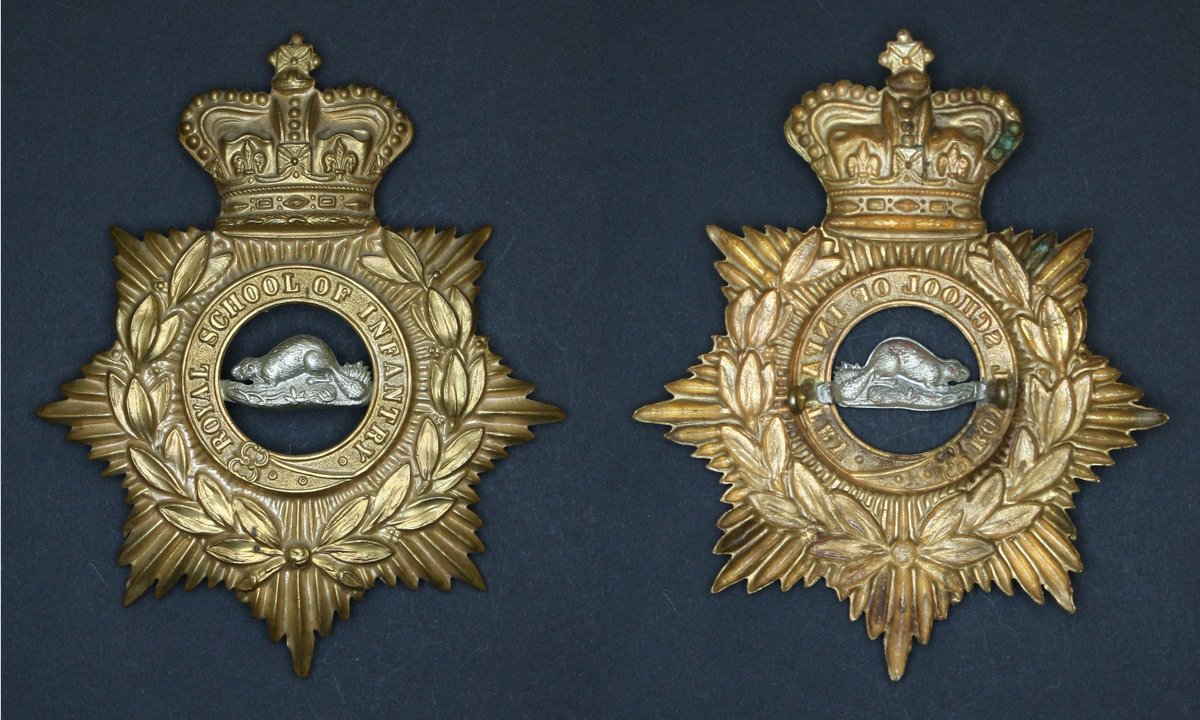
The Infantry School Corps Helmet Plates
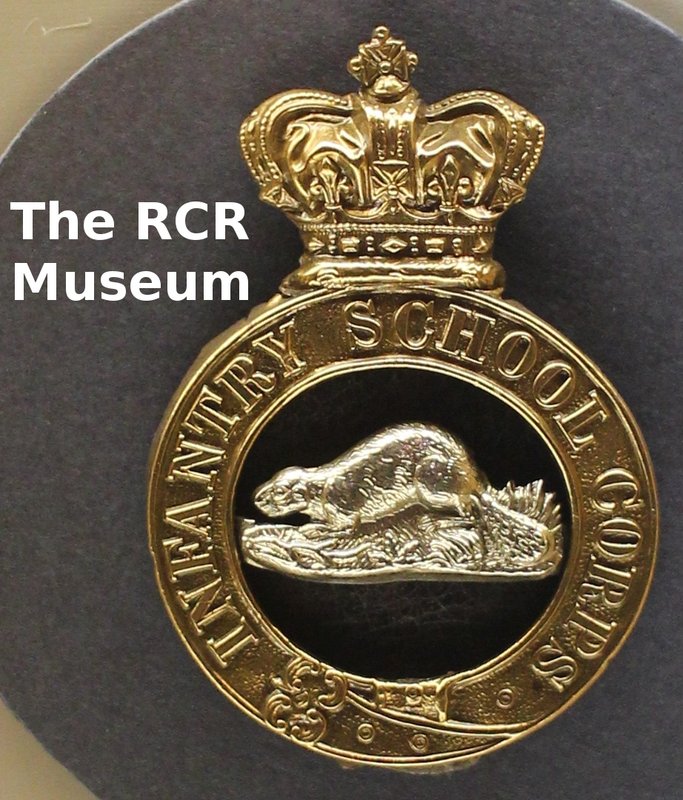
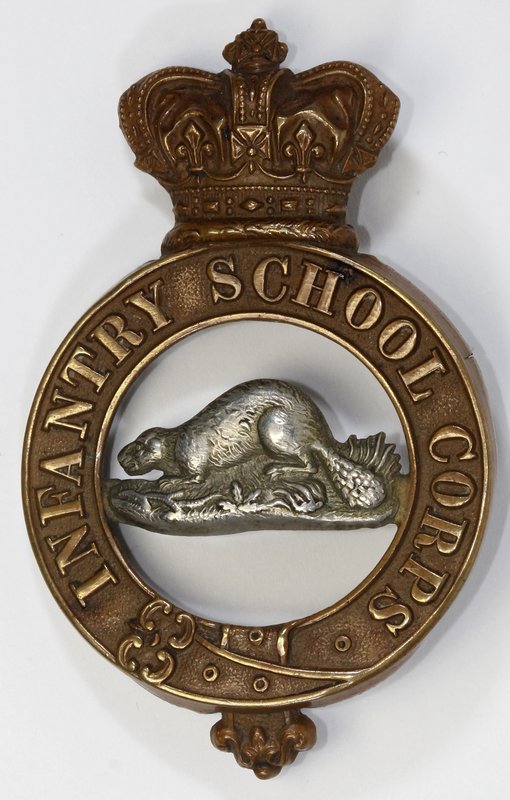
The standard 1883 helmet plate for the Infantry School Corps was the Home Service Helmet Plate two-piece design (in use from 1878 - 1914) consisting of a ‘Star Plate’ and a ‘Star Plate Centre’. The Infantry School Corps helmet plate followed the British version, with the centre garter reading "Royal School of Infantry" but with a uniquely Canadian star plate centre of a silver beaver design.
The helmet plate was worn on the white universal helmet.
My own collection contains two versions of the standard 1883 helmet plate, one in brass, and one in gilt which the an officers' pattern. (The Regimental Museum displays two other variations of the helmet plate, these more ornate versions are labelled as officer patterns but I have found no documentation authorizing their use.)
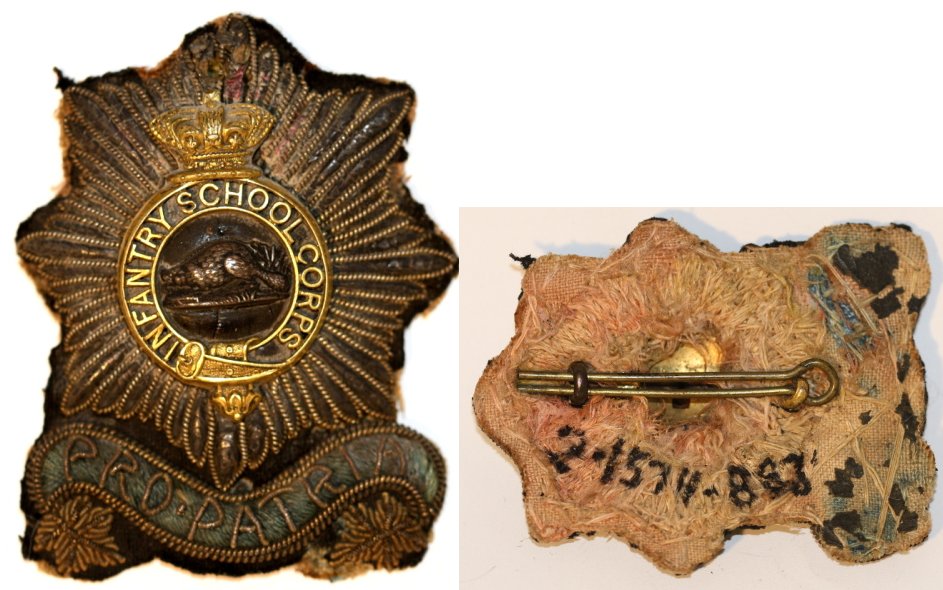
The Infantry School Corps Officers' Bullion Wire Badges
The RCR existed as the “Infantry School Corps” from 1883 until 1992, when the regimental name was changed to the “Canadian Regiment of Infantry.” Badges were named to the “Infantry School Corps” with the Canadian identity shown by a beaver as the central figure. While metal badges are known for cap, helmet and collars, they are not common among collectors or museums.
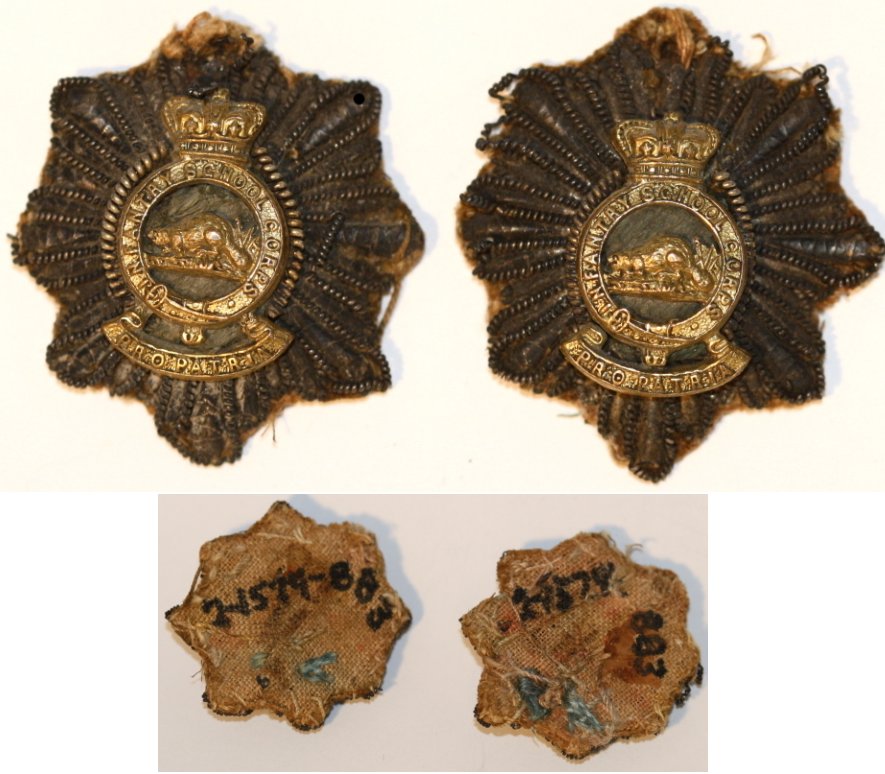
The officers of the Regiment during the I.S.C. period also had a bullion wire badge, with a brass and silver centrepiece. To give an idea of how rare these might be today, in the nine years of the Infantry School Corps, the regimental history lists only 36 officers who joined the Regiment. The few badges that might have been made for them, coupled with the recognized fragility of the wire badges, assures that the survival of any of these badges is a remarkable event.
The bullion wire badges pictured above may be the only surviving set of these badges and are now in The Regimental Rogue's collection.
The following photos show examples of bullion badges being worn by officers of the Canadian Infantry School Corps.
 Major Beaufort Henry Vidal wearing one version of the bullion Infantry School Corps badge in an 1891 photo. Major Vidal served with the Regiment from 1883 until 1899. A veteran of the Abyssinia Campaign of 1867, he would retire in 1907 at the rank of Brigadier General, having held the appointment of Inspector General. |
 Lieutenant Robinson Lyndhurst Wadmore wearing bullion collar badges. A veteran of the Northwest Rebellion, the image was taken shortly after his retrn from that campaign. Wadmore would serve in the Regiment from 1883 until 1910, and command the Regiment from 1905 until 1910, retiring at the rank of Lieutenant Colonel. (Library and Archives Canada image.) |

Officers of "C" Company, the Infantry School Corps, photographed in 1891. Close examination reveals that at least two variations of the bullion cap badge were in use. (Library and Archives Canada image.)
The Infantry School Corps "Eight-Pointed Star"
This was first eight-pointed star worn by the Regiment.
The Infantry School Corps Glengarry Badges
These badges, worn by officers and soldiers on the glengarry were produced in both gilt and brass with a silver beaver centre piece.
- The O'Leary Collection; Medals of The Royal Canadian Regiment.
- Researching Canadian Soldiers of the First World War
- Researching The Royal Canadian Regiment
- The RCR in the First World War
- Badges of The RCR
- The Senior Subaltern
- The Minute Book (blog)
- Rogue Papers
- Tactical Primers
- The Regimental Library
- Battle Honours
- Perpetuation of the CEF
- A Miscellany
- Quotes
- The Frontenac Times
- Site Map
QUICK LINKS
1. Introduction
2. Crowns, Cyphers and Controversy
3. Rare and Unusual Regimental Badges
4. Shoulder Flashes and Titles
1883
1894-1902, 1919-27
South African War
EviiR Badges (1902-11)
GvR Badges (1911-19)
St Edward's Crowns (1927-70s)
Maj Cock, M.C., Collection (1933)
Imperial Crowns (1926-50s)
Imperial Crowns (1960s-80s)
Dress Regs - 1960
Dress Regs - 1967
1980s
1990s
2000+
Woven Badges
Blazer Badges
Pipers' Badges
Belt Buckles
Miscellaneous
Crowns, Cyphers and Stars
RCR Headdress
Badged Brodies
Badge References