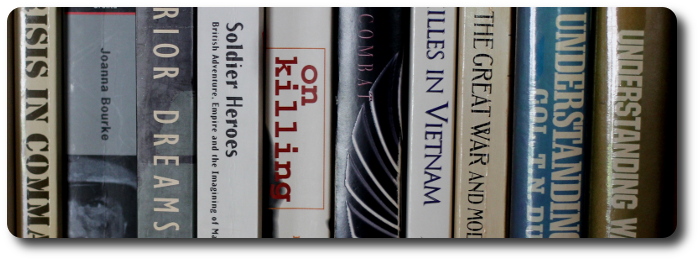
The Canadian Army Reading List - Version 1, September 2001
Introduction -
Doctrine -
Military Theory -
Canadian Military Heritage -
Military History -
Campaign and Battle Studies -
Leadership -
The Human Factor -
Technology -
Future Warfare -
Peacekeeping -
Politics, International Relations and Economics -
Ethics, Domestic Issues and Social Trends -
Fiction
The Human Factor
Ardant du Picq, Charles. Etudes sur le combat: combat antique et combat moderne. Paris, Editions Champ Libre, 1978. Available in English.
The author argues that moral factors, such as élan, can outweigh the physical power on the battlefield. This work had a significant influence on French doctrine and training during the nineteenth and early twentieth centuries.
Burrell, Brian. Damn the Torpedoes: Fighting Words, Rallying Cries, and the Hidden History of Warfare. New York, McGraw‑Hill, 1999.
The author draws upon Charles Ardant du Picq, S. L. A. Marshall and Hans Delbrück’s findings to provide an excellent discussion on the performance of soldiers under fire.
Marshall, S.L.A. Men Against Fire: The Problem of Battle Command in Future War. Gloucester, MA: Peter Smith, 1978.
First published in 1947, this book highlights General Marshall's perception of soldiers in combat based on his own experiences in two world wars and on extensive interviews of combat troops. Subject to great debate since its publication, this book influenced American training methods for a generation.
- The O'Leary Collection; Medals of The Royal Canadian Regiment.
- Researching Canadian Soldiers of the First World War
- Researching The Royal Canadian Regiment
- The RCR in the First World War
- Badges of The RCR
- The Senior Subaltern
- The Minute Book
- Rogue Papers
- Tactical Primers
- The Regimental Library
- Battle Honours
- Perpetuation of the CEF
- A Miscellany
- Quotes
- The Frontenac Times
- Site Map
QUICK LINKS
Commander Canadian Army's Reading List 2015
Infantry School Reading List
By Rank
By Subject
Canadian Army Reading List
Introduction
Doctrine
Military Theory
Canadian Military Heritage
Military History
Campaign and Battle Studies
Leadership
The Human Factor
Technology
Future Warfare
Peacekeeping
Politics, International Relations and Economics
Ethics, Domestic Issues and Social Trends
Fiction