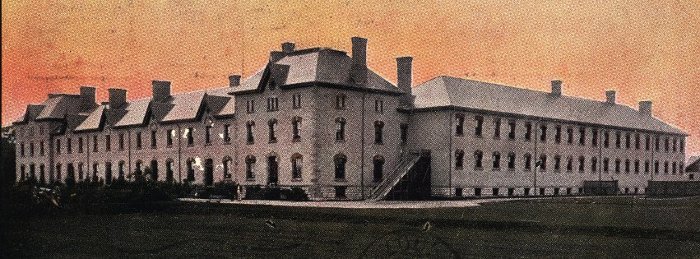
History of Military District No. 1 in the Late War
Off Parade; newsletter of No. 1 District Depot, Wolseley Barracks, July 1946
By: Capt E. Kelleher, P.R.O., M.D. 1
Military District No. 1, which is rightfully proud of its ranking number on the national map of Canada, more than lived up to its fine military traditions in the Second World War.
At the outbreak of the war in 1939, there were only 400 permanent force troops in this District, while the non-permanent active militia were counted at some 3,500 men.
But the call to the Colours was answered in a swelling stream of combat manpower. It is a matter of record today that 80,000 Western Ontario men enlisted in the three services, and of that total 50,000 joined the Army. And one must pay tribute also to the large numbers of girls and women from the western counties who joined the C.W.A.C. and took over vital Army jobs.
M.D. No. 1 maintained a fast pace in the all-out war effort, first under Brig. (later Maj.-Gen.) D.J. MacDonald, C.B.E., D.S.O., M.C., who was District Officer Commanding at the outbreak of war; and then under his successor, Brig. P. Earnshaw, C.B.E., D.S.O., M.C., who still handles the reins of this key District.
No time was lost in setting up the machinery to school recruits for this stark business of war. Basic training centres were established at Chatham, Woodstock, Kitchener, Listowel, and Stratford. Chatham alone handled a total of 18,000 recruits in its career. Later came A-29 Canadian Infantry Corps Training centre at Camp Ipperwash, which graduated thousands of fully-trained soldiers to front-line units.
Woodstock developed into S-5 Canadian Driving and Maintenance School, which drew candidates from around the country for special training. It is estimated that 17,000 officers and men completed courses at that Centre.
And from men's basic training, Kitchener grew into No. 3 C.W.A.C. Basic Training Centre. One authority has said that more than two-thirds of the nation's C.W.A.C.'s took their "basic" at Kitchener. One of the most cosmopolitan of army camps, Kitchener was the alma mater of girls from Newfoundland, the United States, British West Indies, Bahamas, Bermuda, and even some who had escaped from Nazi-occupied countries of France, Poland and Czecho-Slovakia.
Eventually, Kitchener was the only C.W.A.C centre left on the war establishment, and it handled basic as well as officer training.
M.D. No. 1 also gained Central Mechanization Depot, located in London, and popularly known as Canada's "largest Army garage." With its branches in Hagersville and New Sarum, it still functions as the most extensive Army depot of its kind.
The Royal Canadian Regiment, the District's only permanent force unit, was the first to be mobilized.
The following N.P.A.M. regiments were also mobilized during the war:
- 6th Armoured Regiment (1st Hussars) of London,
- Essex Scottish Regiment of Windsor,
- Canadian Fusiliers (City of London Regiment),
- Kent Regiment of Chatham,
- Elgin Regiment of St. Thomas,
- Perth Regiment of Stratford,
- Highland Light Infantry of Canada, of Galt,
- Scots Fusiliers of Canada, of Kitchener,
- 30th Reconnaissance Regiment of Windsor, and the
- Oxford Rifles of Woodstock.
Other units mobilized in M.D. No. 1 included:
- Royal Canadian Artillery (R.C.A.)
- 100th Light Anti-Aircraft Battery, Listowel.
- 98th (Bruce) Anti-Tank Battery, Pert Elgin.
- 16th Field Battery, Guelph.
- 26th (Lambton) Field Battery, Sarnia.
- 29th Field Battery, Guelph.
- 43rd Field Battery, Guelph.
- 55th Field Battery, London.
- 63rd Field Battery, Guelph.
- 99th Field Battery, Wingham.
- 12th Medium Battery, London.
- 97th Field Battery, Walkerton.
- No. 1 Artillery Holding Unit, London.
- No. 4 Light Anti-Aircraft Regiment, R.C.A., London.
- 48th Light Anti-Aircraft Battery, R.C.A., Watford.
- 9th Light Anti-Aircraft Battery, R.C.A., Walkerton.
- Royal Canadian Engineers (R.C.E.)
- 7th Field Company, London.
- 11th (Lambton) Field Company, Sarnia.
- 1st Field Park Company (Lambton), Sarnia.
- No. 1 Road Construction Company, R.C.E.
- 9th Field Company, London.
- H.Q. 2nd Infantry Division, Sarnia.
- Royal Canadian Corps of Signals (R.C.C.S.)
- 1st Canadian Division Signals, London.
- 1st A.A. Brigade H.Q., London.
- Royal Canadian Army Service Corps (R.C.A.S.C.)
- No. 3 Company, London.
- No. 11 Company, London.
- 4th Division Petrol Company, R.C.A.S.C., London.
- Royal Canadian Army Medical Corps (R.C.A.M.C.)
- No. 2 Base Depot of Medical Stores, Kitchener.
- No. 11 Field Ambulance, Guelph.
- No. 15 Field Ambulance, London.
- No. 24 Field Ambulance, Kitchener.
- No. 3 General Hospital, Windsor.
- No. 10 General Hospital, London.
- 28th Field Ambulance, R.C.A.M.C., London.
- 1st Field Hygiene Section, R.C.A.M.C., London.
- Royal Canadian Ordnance Corps (R.C.O.C.) .
- No. 1 Armoured Brigade Ordnance Field Park.
- No. 1 Army Field Workshop, R.C.O.C.
- No. 2 Mobile Laundry and Decontamination Unit.
- No. 4 General Labour Section, R.C.O.C.
- No. 4 Mobile Laundry and Decontamination Unit, Windsor.
- Royal Canadian Electrical and Mechanical Engineers (R.C.E.M.E)
- 16th L.A.D.
- 17th L.A.D.
- 18th L.A.D.
- 19th L.A.D.
- 20th L.A.D.
- 21st L.A.D.
- 22nd L.A.D.
- 23rd L.A.D.
- 24th L.A.D. (all of London)
- Canadian Provost Corps (C. Pro. C.)
- 3rd Provost Company.
- 4th Provost Company.
- 8th Provost Company.
- 11th Provost Company.
- Veterans' Guard of Canada.
- No. 2 Company.
- No. 40 Company

- The O'Leary Collection; Medals of The Royal Canadian Regiment.
- Researching Canadian Soldiers of the First World War
- Researching The Royal Canadian Regiment
- The RCR in the First World War
- Badges of The RCR
- The Senior Subaltern
- The Minute Book
- Rogue Papers
- Tactical Primers
- The Regimental Library
- Battle Honours
- Perpetuation of the CEF
- A Miscellany
- Quotes
- The Frontenac Times
- Site Map
QUICK LINKS
- The Canadian Militia (152)
- Canadian Expeditionary Force (CEF) (137)
- Officers (95)
- Drill and Training (87)
- Army Rations (89)
- Discipline (76)
- The Canadian Army (64)
- The Royal Canadian Regiment (The RCR) (51)
- Leadership (23)
- Humour (50)
- Medals (52)
- Military Theory (42)
- Tradition (38)
- Royal Canadian Navy (RCN) (41)
- Field of Battle (36)
- British Army (32)
- Soldiers' Load (31)
- Halifax (23)
- Remembrance (23)
- Wolseley Barracks (London, Ontario) (23)
- Cold Steel (24)
- Battle Honours (17)
- Royal Canadian Air Force (RCAF) (20)
- Pay (12)
- The Vimy Pilgrimage (1936) (11)
- The Battle of Paardeberg (18-27 Feb 1900) (10)