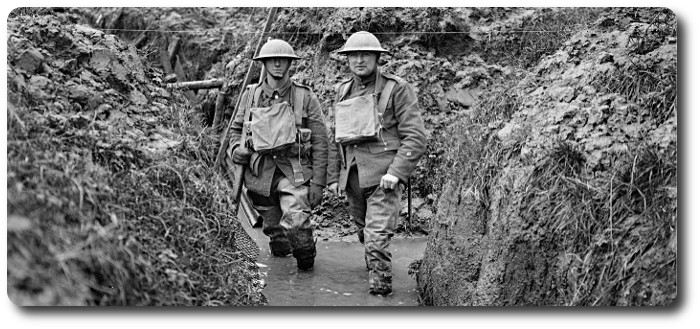
British Compiling Dictionary to Preserve Slang of Tommy
Words and Phrases Used by English Soldiers in the Trenches to Be Placed in Museum—Seek History of Words
St. Petersburg Times, 19 November 1921
Although this article isn't specifically about the CEF, it has been tagged as such to keep it with other First World War material.
London, No. 18.—An effort is to be made to preserve in the British museum the war time slang of the British Tommy. For the benefit of the students of the great war a dictionary is in the course of compilations dealing with the many words and phrases born of the war.
The secretary of the imperial war museum has issued a request for notes on the subject giving the slang terms used in the British army, together with the meaning of the words and, if possible, their derivation.
Much of this slang was a legacy of the old regular soldier at Mons and originated for the most part in the east. The most popular and most romantic and sentimental was "blighty." That is now almost universally used. It was derived from the Hindustani and means home.
However, the history of such expressions as "kip," "posh," "wangle," "eyewash," "swank," "square pushing" or "wind-up" is not yet written, and the secretary aforesaid is now carefully collating his data. In his request for data the secretary naively suggests "that, of course, many of the army terms are not polite and hardly fit for publication."
As a rule, however, the slang of the British Tommy has a much more wholesome derivation than most of the French "argot les tranches."
One Trench Language
Perhaps the most astounding thing about the army slang of the British is the generality of its uses. Those knowing Great Britain know that the dialect of no two counties is alike. The accent of the Lancashiremen is as different as possible from that of his neighbor, the Yorkshireman, while the troops from Northumberland were completely and wonderfully unintelligible to the rest of the British Army. Many of the Welsh regiments, too, could speak no other language, but their native Welsh. Yet the language of the trench was the same for all.
To all a "brass hat" was a staff field officer. True, the Scotsman put two extra "rs" into it, and the Northumbrian, as he is wont, "gutturalled" the "r" and made it appear like—well, certainly nothing which could be printed.
Some of the examples are as follows:
- Air-flappers—Army signallers.
- Archie—An anti-aircraft gun. (Probably a corruption of air-craft.)
- Bully—Bully Beef—Tinned corned beef. (A relic of South Africa.)
- Buchshee—Anything which is to spare or can be borrowed. (Derived from the African beggars' terms backsheesh.)
- Blighty—Home, England. (Hindustani.)
- Bynt—A young woman (Arabic).
- Cushy—Soft. (Derived from cushion. A cushy wound is a slight wound. A cushy job is a task which can be performed sitting down.)
Some Hindu, Too.
- Dekko—To look. (Hindustani.)
- Eyewash—Over-elaboration, generally in some scheme to hoodwink a general.
- Emma Gees—The signalling term for the initials M.G., i.e., machine gunner.
- Jerry—A German soldier.
- Kip—To sleep; a bed.
- Lancejack—A lance corporal.
- Leaf—Leave of absence (Corruption of leave.)
- Monjy—Bread, or something to eat. (Corruption of the French.)
- Posh—Ultra smart.
- Padre—An army chaplain.
- Quarter bloke—The quartermaster.
- Red Cap—An army policeman who wears a red cap.
- Scupper—To wipe out completely.
- Square Pushing—To walk out with a sweetheart in a soldier's best uniform.
- Sapper—An engineer.
- Swanking—Four-flushing.
- Snob—The regimental bootmaker.
- Snips—The regimental tailor.
- Wangle—To achieve an objective by doubtful means. "Wangling leaf" means to get leave of absence by giving a false reason.
- Wind-up—To be nervous and apprehensive. It does not necessarily mean frightened; many of the bravest soldiers confessed to having the "wind up." In the officers' mess it was known generally as the "vertical breeze" or the "draught."

- The O'Leary Collection; Medals of The Royal Canadian Regiment.
- Researching Canadian Soldiers of the First World War
- Researching The Royal Canadian Regiment
- The RCR in the First World War
- Badges of The RCR
- The Senior Subaltern
- The Minute Book
- Rogue Papers
- Tactical Primers
- The Regimental Library
- Battle Honours
- Perpetuation of the CEF
- A Miscellany
- Quotes
- The Frontenac Times
- Site Map
QUICK LINKS
- The Canadian Militia (152)
- Canadian Expeditionary Force (CEF) (137)
- Officers (95)
- Drill and Training (87)
- Army Rations (89)
- Discipline (76)
- The Canadian Army (64)
- The Royal Canadian Regiment (The RCR) (51)
- Leadership (23)
- Humour (50)
- Medals (52)
- Military Theory (42)
- Tradition (38)
- Royal Canadian Navy (RCN) (41)
- Field of Battle (36)
- British Army (32)
- Soldiers' Load (31)
- Halifax (23)
- Remembrance (23)
- Wolseley Barracks (London, Ontario) (23)
- Cold Steel (24)
- Battle Honours (17)
- Royal Canadian Air Force (RCAF) (20)
- Pay (12)
- The Vimy Pilgrimage (1936) (11)
- The Battle of Paardeberg (18-27 Feb 1900) (10)