Quotes - Morale (page 1)
The Strands of War are four in number, ...
I. The quality and capability of the commander.
II. The quality and capability of the troops.
III. Morale.
IV. Resources.
- Lt.-Col. A.H. Burne, DSO, RA (Ret'd), The Art of War on Land, 1947
The success of Kapyong [April 24-5, 1951] was due mainly to high morale and to good company, platoon and section commanders. ...That is something we should never overlook in our military training. Too much officer training is aimed at high levels of command and not enough at the company and platoon level. - Colonel J.R. Stone, "Memoir: Kapyong," CF Infantry Newsletter, 3 (1974), quoted in John A. English, A Perspective on Infantry, 1981
The troops who fight the best do so, not because of their nationality, but because at that specific time they are the best trained, the best disciplined and the best led on the field. - Strome Galloway, The General Who Never Was, 1981
You do well apprehend that good order and military discipline are the chief essentials in an army. But you must ever be aware that an army cannot preserve good order unless its soldiers have meat in their bellies, coats on their backs and shoes on their feet. All these are as necessary as arms and munitions. I pray you will never fail to look to these things as you may do to other matters ... - Marlborough, to his Quartermaster-General, Dec 1703, quoted in J.M. Bereton, The British Soldier
... the British soldier's morale was fed not only by patriotism (`Your Country needs you') but by the unique regimental spirit that has been the envy of other armies down to the present day: one cannot let the Regiment down. - J.M. Bereton, The British Soldier
... the clever disguise of bully beef is an incentive to good morale. Tonight it was made into pancakes. - Cecil Beaton, 1943, quoted in John Ellis, On the Front Lines
When a general complains of the morale of his troops, the time has come to look into his own." - George C. Marshall
A Manchester n.c.o. whose unit won ground [at Somme], provided a glimpse of the price paid: 'Just in front of me lay a boy I had cursed just the night before for being drunk. He lay quite flat, and might have been resting, except there was a big ragged hole at the base of his skull where a bullet had come out. Next to me, a man was trying with grimy hands to dab a field dressing on the back of a lance corporal who had been shot through the chest and sat up clutching his knees and rocking to and fro. My platoon officer lay on his back. His face and hands were as white as marble. His lungs were labouring like bellows. In a minute or two, he was dead. 'D'you think there's any chance for us, sergeant?' a man whispered. I said it would be all right. - Alan Lloyd, The War in the Trenches, 1976
The Pentagon set more store in other measures designed to improve the soldier's morale. The Morale Division (later Information and Education Division) of the General Staff was formed with morale improvement as one of its main functions; by the end of 1942 there was a morale officer in each regiment. Psychologists warned that once the soldier went overseas, increased isolation from all he had known could increase his morale problems: "Any symbol or representation of the culture that he has left assumes exaggerated value. A visitor from home, sports scores, moving pictures, American food or drinks are extraordinarily important for maintaining morale in expeditionary forces." Following this advice, the Pentagon encouraged overseas tours by American musicians and entertainers. It saw to it that men in uniform viewed the latest Hollywood films as soon as they were released, and sometimes before civilians saw them (the Army mobilized airplanes, landing barges, and even dogsled teams to speed films to remote posts in Alaska and the Aleutians). And the American authorities filled valuable cargo space to North Africa with countless crates of Coca-Cola, to the dismay of their British allies. - Lee Kennett, G.I.; The American Soldier in World War II, 1987
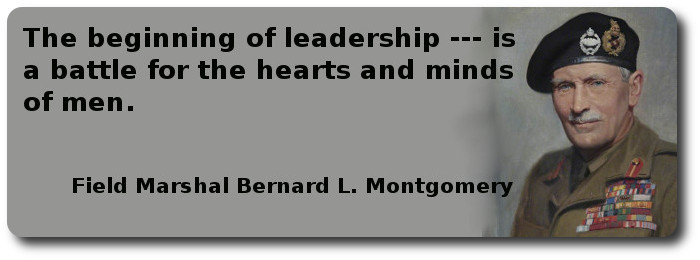
Field Marshal Sir Bernard Montgomery may have been thinking of the G.I.s when he wrote in his Memoirs that it was important not to spoil the soldier with too many conveniences and comforts. The British soldier, he wrote, "will do anything you ask of him so long as you arrange he gets his mail from home, the newspapers and, curiously enough, plenty of tea." - Lee Kennett, G.I.; The American Soldier in World War II, 1987
The G.I. could be led, it was often said, but he could not be driven. S. L. A. Marshall reported in this connection a particularly tragic episode that occurred in the Marshall Islands. The American infantry had been pinned down on the invasion beach by heavy Japanese fire; a "prodding" order came down from division headquarters, and a lieutenant cautiously worked his way up to the most advanced of the riflemen and told him to move forward. The young soldier shouted in a rage, "So the whole goddamned Army wants to kill me, does it? Okay, Lieutenant, here I go, but watch what happens." The soldier sprang up and was cut down before he took two steps. The effect on the other men was shattering. - Lee Kennett, G.I.; The American Soldier in World War II, 1987
Tradition, efficiency, and morale-military or otherwise-are not created overnight. - Minutemen of '62 by Robert F. McGraw, presented in John T. Hubbell (Ed), Battles Lost & Won; essays from Civil War History, 1975
Field-Marshal Montgomery has warned, 'We must be very careful what we do with British infantry. They are the people who do the hard fighting and the killing.... Their fighting spirit is based largely on morale and regimental esprit de corps. On no account must anyone tamper with this.' - Byron Farwell, Queen Victoria's Little Wars, 1972
"When a general complains of the morale of his troops, the time has come to look into his own." - George C. Marshall, quoted in James F. Dunnigan and Albert A. Nofi, Dirty Little Secrets; Military Information You're Not Supposed to Know, 1990
Time and time again they threw their men forward, confident that this time a little more preparation, a few more men, and an extra dash of sheer courage would sufiice to break the enemy's will to resist. They never realised that they were not fighting his 'will', but his machine guns. And they were implacable and unshakeable. Morale was an irrelevancy to them; all they needed was enough water and bullets. The man counted for nothing. The machine had taken over. Thus Guy Chapman's poignant eulogy to those going up to the front on the Somme: 'Hump your pack and get a move on. The next hour, man, will bring you three miles nearer to your death. Your life and your death are nothing to these fields - nothing, no more than it is to the man planning the attack at GHQ. You are not even a pawn. Your death will not prevent future wars, will not make the world safe for your children. Your death means no more than if you had died in your bed.'- John Ellis, The Social History of the Machine Gun, 1976
Battalions certainly differed in their character and their competence both from others and within themselves over time. Battalions are much like an organic family. They are held together by intangibles - leadership, comradeship, motivation, morale - that defy quantification or even easy description. In good units, soldiers feel - know - they are in the best section in the best company, in the best battalion. Many veterans cite the character and capability of the commanding officer as vital factors in shaping a battalion's collective character. - Terry Copp and Bill McAndrew, Battle Exhaustion; Soldiers and Psychiatrists in the Canadian Army, 1939-1945, 1990
"A lot of people have morale confused with the desire to fight. I don't know of one soldier out of ten thousand who wants to fight ... The old-timers are sick to death of battle, and the new replacements are scared to death of it. And yet the Company goes on into battle and it is a proud Company" - Ernie Pyle, American Journalist, quoted in chapter notes to Terry Copp and Bill McAndrew, Battle Exhaustion; Soldiers and Psychiatrists in the Canadian Army, 1939-1945, 1990
At one point during the winter of 1916-17, General Odlum decided to cancel the rum issue to the [11th Canadian Infantry] Brigade. Instead, the troops in the forward area were to be served hot cocoa. Now it is a fact thet the rum issue sometimes led to abuse; some soldiers got less than their share, while other managed to scrounge more and became drunk. A favourite soldier's song included the line, "Where's the Sergeant-Major? I know where he is; boozing up the privates' rum." But as can be imagined, General Odlum's innovation got minus zero in the front-line opinion polls. After a time he was overruled by the divisional commander [Major-General David Watson] , and the rum ration was restored. - Lt.-Gen. E.L.M. Burns, C.C., D.S.O., O.B.E., M.C., General Mud, 1970
A Pot of Tea
You make it in your mess-tin by the brazier's rosy gleam;
You watch it cloud, then settle amber clear;
You lift it with your bay'nit, and you sniff the fragrant steam;
The very breath of it is ripe with cheer.
You're awful cold and dirty, and a-cursin' of your lot;
You scoff the blushin' 'alf of it, so rich and rippin' 'ot;
It bucks you up like anythink, just seems to touch the spot:
God bless the man that first discovered Tea!
Since I came out to fight in France, which ain't the other day,
I think I've drunk enough to float a barge;
All kinds of fancy foreign dope, from caffy and doo lay,
To rum they serves you out before a charge.
In back rooms of estaminays I've gurgled pints of cham;
I've swilled down mugs of cider till I've felt a bloomin' dam;
But 'struth! they all ain't in it with the vintage of Assam:
God bless the man that first invented Tea!
I think them lazy lumps o' gods wot kips on asphodel
Swigs nectar that's a flavour of Oolong;
I only wish them sons o' guns a-grillin' down in 'ell
Could 'ave their daily ration of Suchong.
Hurrah! I'm off to battle, which is 'ell and 'eaven too;
And if I don't give some poor bloke a sexton's job to do,
To-night, by Fritz's campfire, won't I 'ave a gorgeous brew
(For fightin' mustn't interfere with Tea).
To-night we'll all be tellin' of the Boches that we slew,
As we drink the giddy victory in Tea.
Rhymes of a Red Cross Man
by Robert W. Service
1916
- The O'Leary Collection; Medals of The Royal Canadian Regiment.
- Researching Canadian Soldiers of the First World War
- Researching The Royal Canadian Regiment
- The RCR in the First World War
- Badges of The RCR
- The Senior Subaltern
- The Minute Book (blog)
- Rogue Papers
- Tactical Primers
- The Regimental Library
- Battle Honours
- Perpetuation of the CEF
- A Miscellany
- Quotes
- The Frontenac Times
- Site Map